WARRIOR RESET · INTERACTIVE FIELD GUIDE
The Trigger-to-Spiral Map
Trace how a situation becomes a thought, feeling and behavior—then discover one place to interrupt the pattern.
Recognize the pattern. Create a new choice.
Choose the next move.
Guide first. Workbook second. Read the ideas at your own pace, then explore the optional exercises.
Explore the content ↓PART ONE / READ & UNDERSTAND
Know the ideas.
Then make them yours.
This overview follows the material in your uploaded workbook. Open whichever sections are useful. Nothing here requires you to answer questions or disclose personal details.
THE ORIGINAL FIELD GUIDE
Practical learning.Your pace.
Understanding the Tactical Mind: The Trigger-to-Spiral Map Workbook
21 PDF pages · 10 numbered workbook lessons plus an invitation page
01Mission brief: recognize the sequence
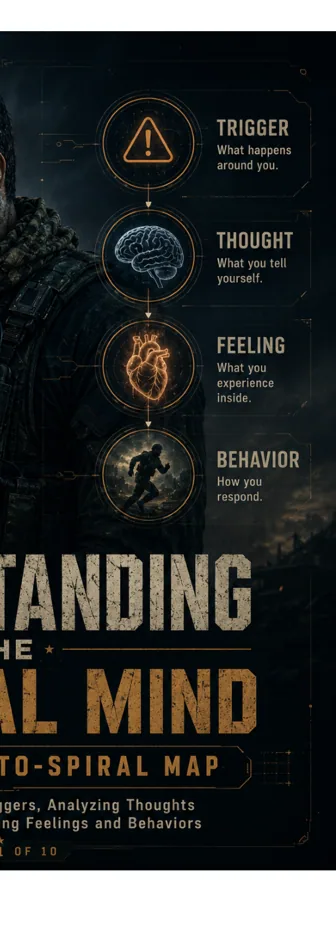
The source maps a situation through trigger, thought, feeling and behavior. The goal is to notice a pattern and create room for choice.
Original source: Workbook p. 1 · PDF p. 202How the spiral works
A trigger can be followed by an interpretation, an emotion or body cue, and an outward response. Mapping these pieces is a reflection tool.
Original source: Workbook p. 2 · PDF p. 403Situational triggers
Possible triggers include an incoming tone, pressure, uncertainty, reminders of past danger, feeling ignored, trapped or disrespected.
Original source: Workbook p. 3 · PDF p. 604Thought capture
Record the first thought and story your mind supplied before deciding whether they are facts.
Original source: Workbook p. 4 · PDF p. 805Analyze the thought
Ask what you know, what you assume, how past experiences could shape the interpretation, and what else may be possible.
Original source: Workbook p. 5 · PDF p. 1006Feelings check-in
Identify emotional signals such as anxiety, frustration, shame, fear, sadness, numbness or overwhelm, and where you notice them.
Original source: Workbook p. 6 · PDF p. 1207Behavior patterns
Notice whether you shut down, snap, isolate, over-explain, leave or go silent; reflect on what each response protects and costs.
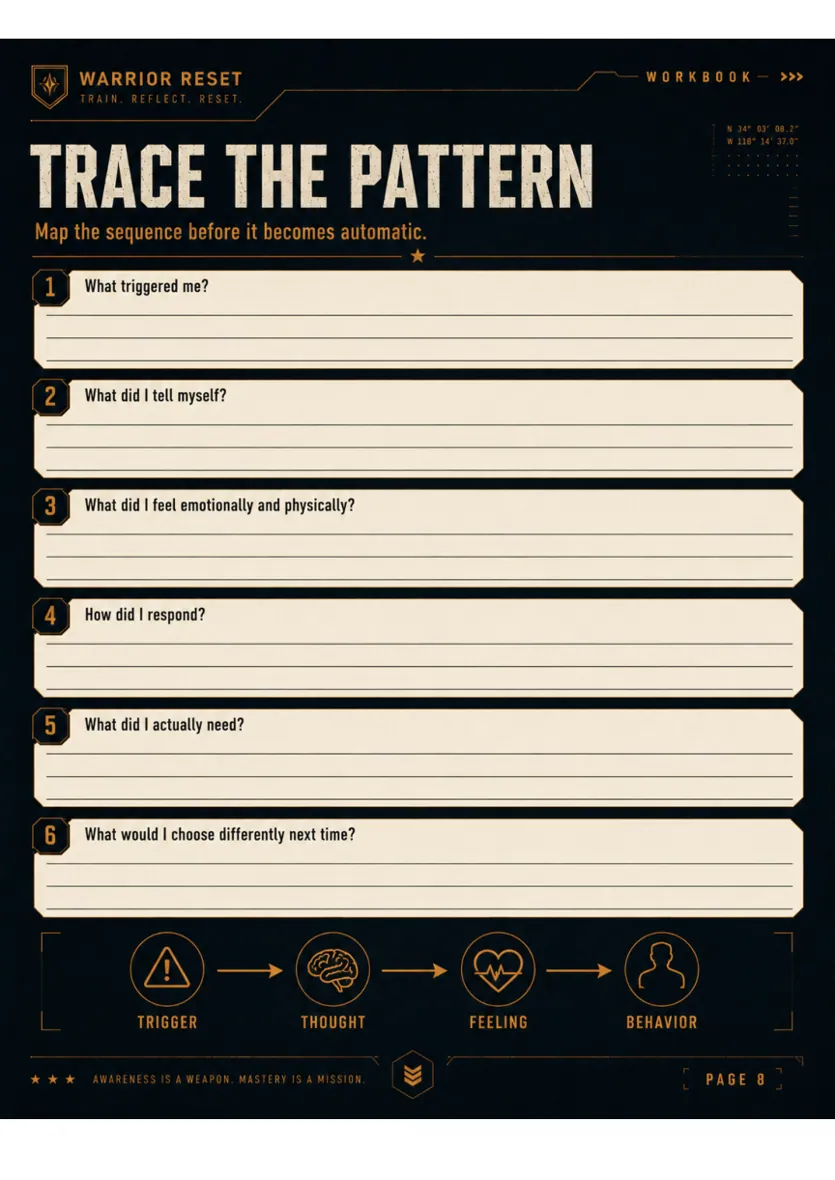
Original source: Workbook p. 7 · PDF p. 1408Trace the pattern
Make a complete personal map of what triggered you, what you told yourself, what you felt, how you responded, and what you needed.
Original source: Workbook p. 8 · PDF p. 1609Interrupt the spiral
The source offers a five-step reset: pause, name the trigger, challenge the thought, identify the feeling, choose a response.
Original source: Workbook p. 9 · PDF p. 1810Mission takeaway
Finish with a concrete practice, a support you may need, and a personal statement about noticing the pattern sooner.
Original source: Workbook p. 10 · PDF p. 20Summaries are adapted from the supplied PDF and should not be interpreted as clinical evidence reviews. Educational coaching reflection; not trauma processing, diagnosis or a clinical assessment.
Ready to apply an idea?
You can answer one question, several, or none. Nothing is graded unless you choose to complete the self-assessment.
Personal answers stay in this browser tab and are cleared on reload. There is no login, automated storage, clinical scoring, or AI interpretation. The source PDF is stored privately in THE WAY's library. If an exercise increases distress, stop or choose appropriate support. For U.S. veterans in crisis, call 988 and press 1.
PART TWO / REFLECT & PRACTICE
The interactive workbook.
Use the original questions in a more flexible format. Everything is optional. This is an educational coaching reflection, not a diagnostic or treatment tool.
Questions are optional. For safety, your answers are not saved automatically. Review and export them before leaving this page.
THE WAY / LEARN · REFLECT · CHOOSE
You can always begin again.
Understanding comes before change. One practical next action is enough.
Explore more workbooks ↗