WARRIOR RESET · INTERACTIVE FIELD GUIDE
Anger Is Running the Mission
Recognize anger signals, map the reaction, make room to pause, and build a practical response plan.
Anger carries information. You choose the response.

Choose the next move.
Guide first. Workbook second. Read the ideas at your own pace, then explore the optional exercises.
Explore the content ↓PART ONE / READ & UNDERSTAND
Know the ideas.
Then make them yours.
This overview follows the material in your uploaded workbook. Open whichever sections are useful. Nothing here requires you to answer questions or disclose personal details.
THE ORIGINAL FIELD GUIDE
Practical learning.Your pace.
Warrior Reset Workbook: Anger Is Running the Mission
39 PDF pages · 20 numbered workbook chapters; some PDF pages contain blank layout space
01Anger is not the enemy
Anger is a signal: it can point to threatened safety, boundaries, respect, or exhaustion. The workbook asks you to notice anger without letting it take command.
Original source: Source workbook p. 1 · PDF p. 202The trigger-to-reaction map
Trace a sequence from what happened to the thought, body cue, emotion, behavior, and result. Noticing the sequence creates room to choose.
Original source: Workbook p. 2 · PDF p. 303CBT: challenge the thought
Notice an automatic anger thought, look for evidence, consider a more balanced interpretation, and choose your next action.
Original source: Workbook p. 3 · PDF p. 404DBT: regulate before you respond
The workbook introduces STOP: Stop, Take a step back, Observe, Proceed wisely. Emotions can be real without deciding your next behavior.
Original source: Workbook p. 4 · PDF p. 605DBT: check the facts
Distinguish what happened from what you assumed, felt or feared. Ask whether you are facing danger, discomfort or misunderstanding.
Original source: Workbook p. 5 · PDF p. 806Check the facts: another pass
Return to the same fact-checking questions with accuracy, not self-criticism, as the goal.
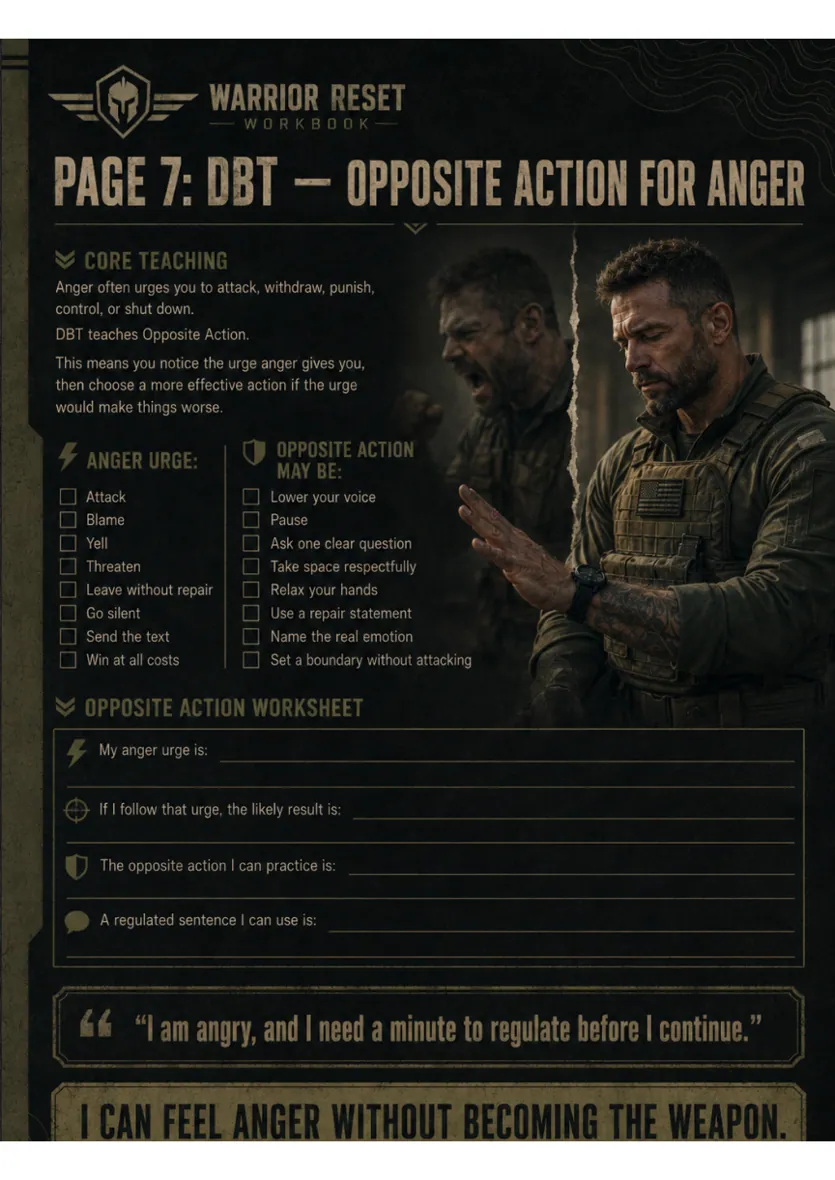
Original source: Workbook p. 6 · PDF p. 1007Opposite action for anger
Notice an urge such as attacking, isolating or retaliating and choose a response that protects your values when the urge would make things worse.
Original source: Workbook p. 7 · PDF p. 1208Change the internal command language
Practice replacing escalating inner commands with short statements that create choice. The workbook calls this an NLP language reframe.
Original source: Workbook p. 8 · PDF p. 1409Anchoring calm
Explore a voluntary calming cue, such as a phrase or small gesture, by pairing it with a comfortable memory. This is a coaching exercise, not a proven trauma treatment.
Original source: Workbook p. 9 · PDF p. 1610Tactical exhale breathing
The workbook offers inhaling for four counts and exhaling for six to eight. Change or skip breath practices if they cause discomfort.
Original source: Workbook p. 10 · PDF p. 1811Box breathing
A second optional breathing pattern uses a four-count inhale, hold, exhale, and hold. Skip breath holds if uncomfortable.
Original source: Workbook p. 11 · PDF p. 2012The 90-second pause
The workbook invites a brief pause before acting on an anger wave. Ninety seconds is a practice cue, not a guarantee of physiological recovery.
Original source: Workbook p. 12 · PDF p. 2213The physical pause
Find an accessible physical interruption, such as stepping aside, feeling your feet, relaxing your jaw, or putting the phone down.
Original source: Workbook p. 13 · PDF p. 2414Somatic anger release
The source suggests a wall push, fist opening, and jaw release as optional ways to notice activation. Avoid exercises that worsen pain or injury.
Original source: Workbook p. 14 · PDF p. 2615Recognize your anger triggers
Look for repeating situations such as feeling ignored, disrespected, rushed, trapped, misunderstood or vulnerable.
Original source: Workbook p. 15 · PDF p. 2816Track the pattern
The workbook offers a seven-day log for triggers, body cues, automatic thoughts, underlying emotions, reactions, and a better next response.
Original source: Workbook p. 16 · PDF p. 3017Responding from calm
Use a clear sentence that names how you feel, when it happens, what you need, and what you will do next. Calm is not the same as passive.
Original source: Workbook p. 17 · PDF p. 3218Repair after anger
Accountability includes what happened, your part, the impact, and an appropriate repair. Explaining a reaction is not the same as repairing harm.
Original source: Workbook p. 18 · PDF p. 3419My anger reset protocol
Bring your triggers, body warnings, a pause action, a breathing or grounding option, a boundary phrase and a repair commitment into one practical plan.
Original source: Workbook p. 19 · PDF p. 3620Final integration
Reflect on the trigger, thought, emotion, pause, phrase and repair you are ready to practice. Your aim is an intentional next response.
Original source: Workbook p. 20 · PDF p. 38Summaries are adapted from the supplied PDF and should not be interpreted as clinical evidence reviews. Educational coaching reflection; not PTSD treatment, anger-management therapy, or a clinical assessment.
Ready to apply an idea?
You can answer one question, several, or none. Nothing is graded unless you choose to complete the self-assessment.
Personal answers stay in this browser tab and are cleared on reload. There is no login, automated storage, clinical scoring, or AI interpretation. The source PDF is stored privately in THE WAY's library. If an exercise increases distress, stop or choose appropriate support. For U.S. veterans in crisis, call 988 and press 1.
PART TWO / REFLECT & PRACTICE
The interactive workbook.
Use the original questions in a more flexible format. Everything is optional. This is an educational coaching reflection, not a diagnostic or treatment tool.
Questions are optional. For safety, your answers are not saved automatically. Review and export them before leaving this page.
THE WAY / LEARN · REFLECT · CHOOSE
You can always begin again.
Understanding comes before change. One practical next action is enough.
Explore more workbooks ↗